You can’t design learning. But, you can design conditions for learning.
There's a fantasy at the heart of modern education (as well as corporate training programs) that if we get the curriculum just right, and the slides polished, the learning objectives crisp enough, learning will seamlessly follow. If you think we can engineer understanding the way we engineer a bridge, or a building, or any physical product…
We can't.
Learning is not a delivery mechanism. It is not something that happens to a person when the right content is transmitted at the right time. It is something that happens inside a person, in ways that are fundamentally beyond any designer's direct control. The best we can do (and it turns out this is quite a lot) is create the conditions in which learning becomes possible, even likely. But we should be humble about the distinction.
The Illusion of Transmission
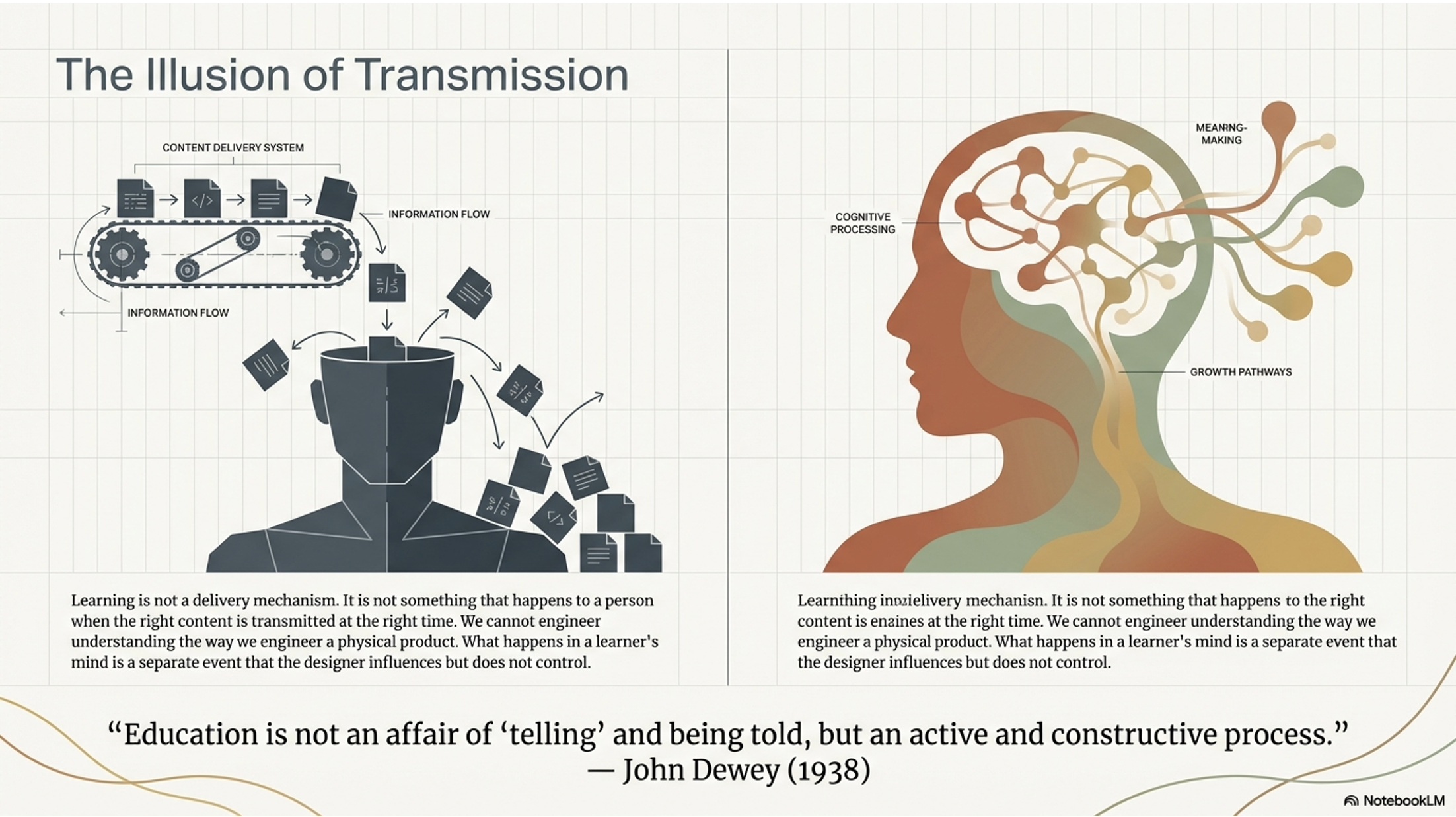
John Dewey saw this problem clearly more than a century ago. He argued that education is "not an affair of 'telling' and being told, but an active and constructive process." In his landmark Experience and Education (1938), he made the case that the teacher's real job is not to deliver knowledge but to engineer the situations in which learners encounter it. The educator's concern, he wrote, should be with "the situations in which interaction takes place" not the content in isolation, but the whole living context around it.
This insight is more radical than it sounds. It means the curriculum is not the learning. The course is not the learning. The slide deck is absolutely not the learning. These are tools for shaping an environment. What happens in a learner's mind is a separate event that the teacher or learning designer influences but does not control.
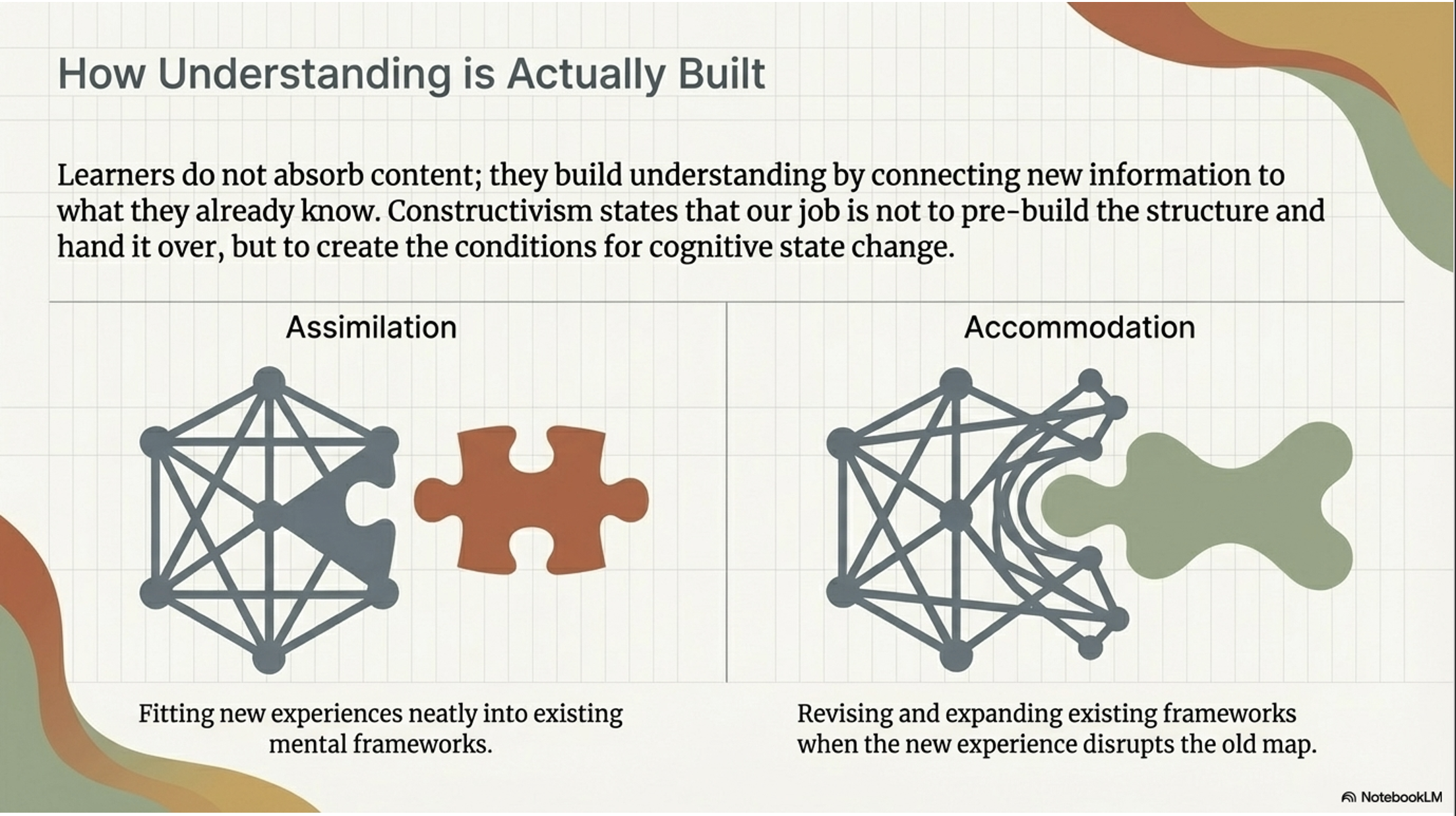
Constructivist learning theory, which built on Dewey and later on the developmental psychology of Jean Piaget, put formal language around this idea. As the University at Buffalo's Center for Teaching summarizes it: "Because knowledge cannot be directly imparted to students, the goal of teaching is to provide experiences that facilitate the construction of knowledge." Learners don't absorb content; they build understanding by connecting new information to what they already know, through a process of assimilation (fitting new experience into existing frameworks) and accommodation (revising those frameworks when the new experience doesn't fit).
This matters enormously for how we think about design. If learners are constructing their own understanding, then the designer's job is to create conditions that make good construction possible, not to pre-build the structure and hand it over.
Unfortunately, a lot of folks take this information and act like explicit teaching does not matter. It 100% does matter in creating conditions for learning.
On the opposite side, you’ll have folks who act like explicit teaching is the ONLY thing that matters. Unfortunately, it’s not that easy.
What Conditions Actually Matter?
So if we're designing conditions rather than learning itself, what conditions are worth designing? Research suggests several that are particularly powerful.
1. The Right Distance Between Challenge and Capability
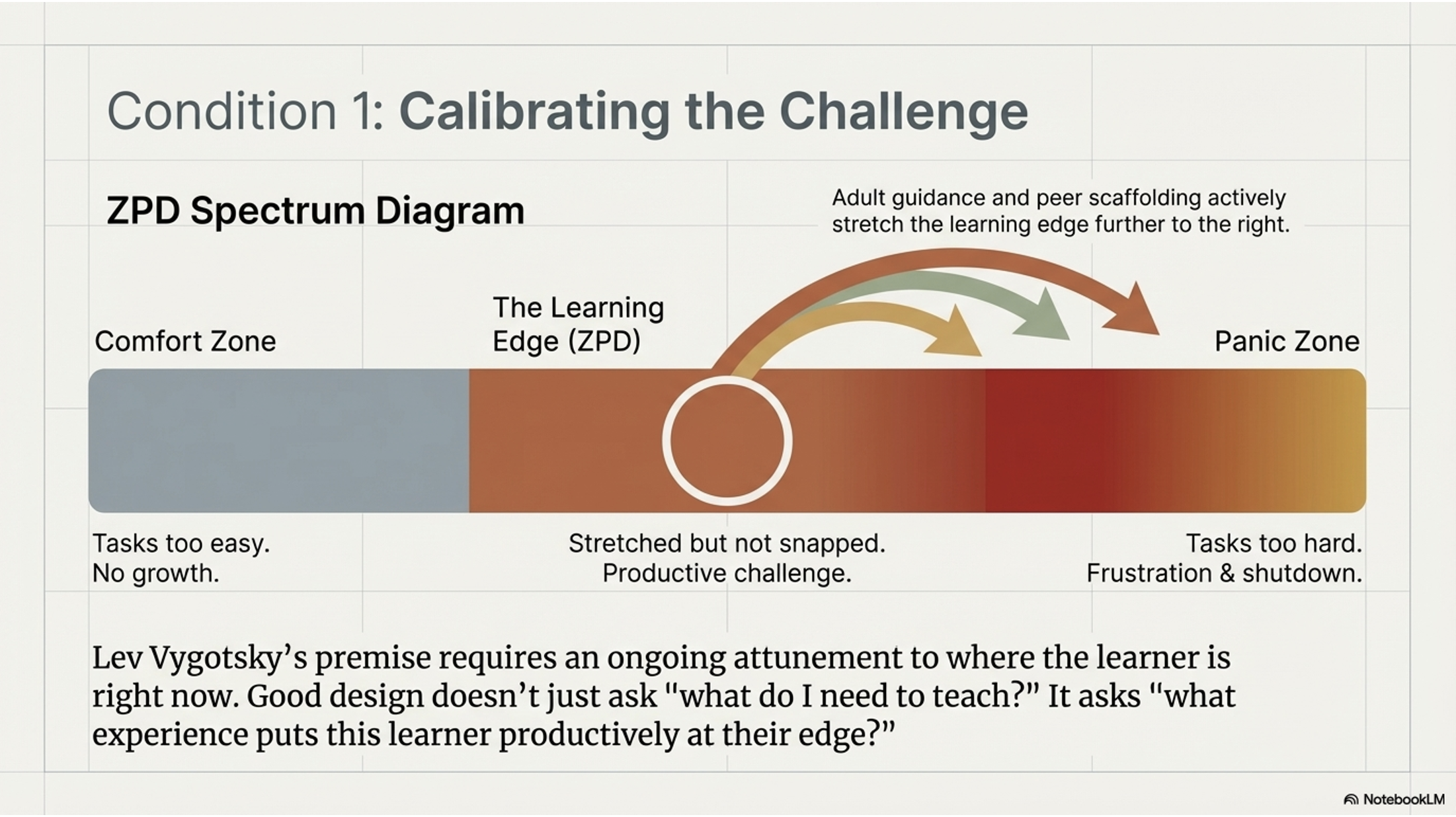
Lev Vygotsky gave us one of the most useful frameworks in all of educational psychology: the Zone of Proximal Development (ZPD). He defined it as "the distance between the actual developmental level as determined by independent problem solving and the level of potential development as determined through problem solving under adult guidance, or in collaboration with more capable peers."
People learn best at the edge of what they can already do. Tasks that are too easy produce no growth. Tasks that are too hard produce frustration and shutdown. The learning zone is the space in between where someone is challenged but not overwhelmed, stretched but not snapped.
If I played tennis against Serena Williams I would not improve and be very frustrated. Similarly, if I played tennis against my four year old daughter I would also not improve and be very frustrated. But, if I played against my brother who is a bit better than me, chances are I could be within that ZPD.
The ZPD reframes the designer's job entirely. Rather than asking "what do I need to teach?" the better question becomes: "where is this learner right now, and what experience would put them productively at their edge?" This is not a question you can answer once and embed in a fixed curriculum. It requires ongoing attunement to the learner.
Vygotsky also emphasized that this zone is most effectively activated through social interaction through dialogue with teachers, peers, or more experienced practitioners. Learning, in his account, is inherently relational. The condition to design is not just an appropriate challenge, but a social context in which help, feedback, and collaborative thinking are available.
2. The Productive Discomfort of Cognitive Dissonance
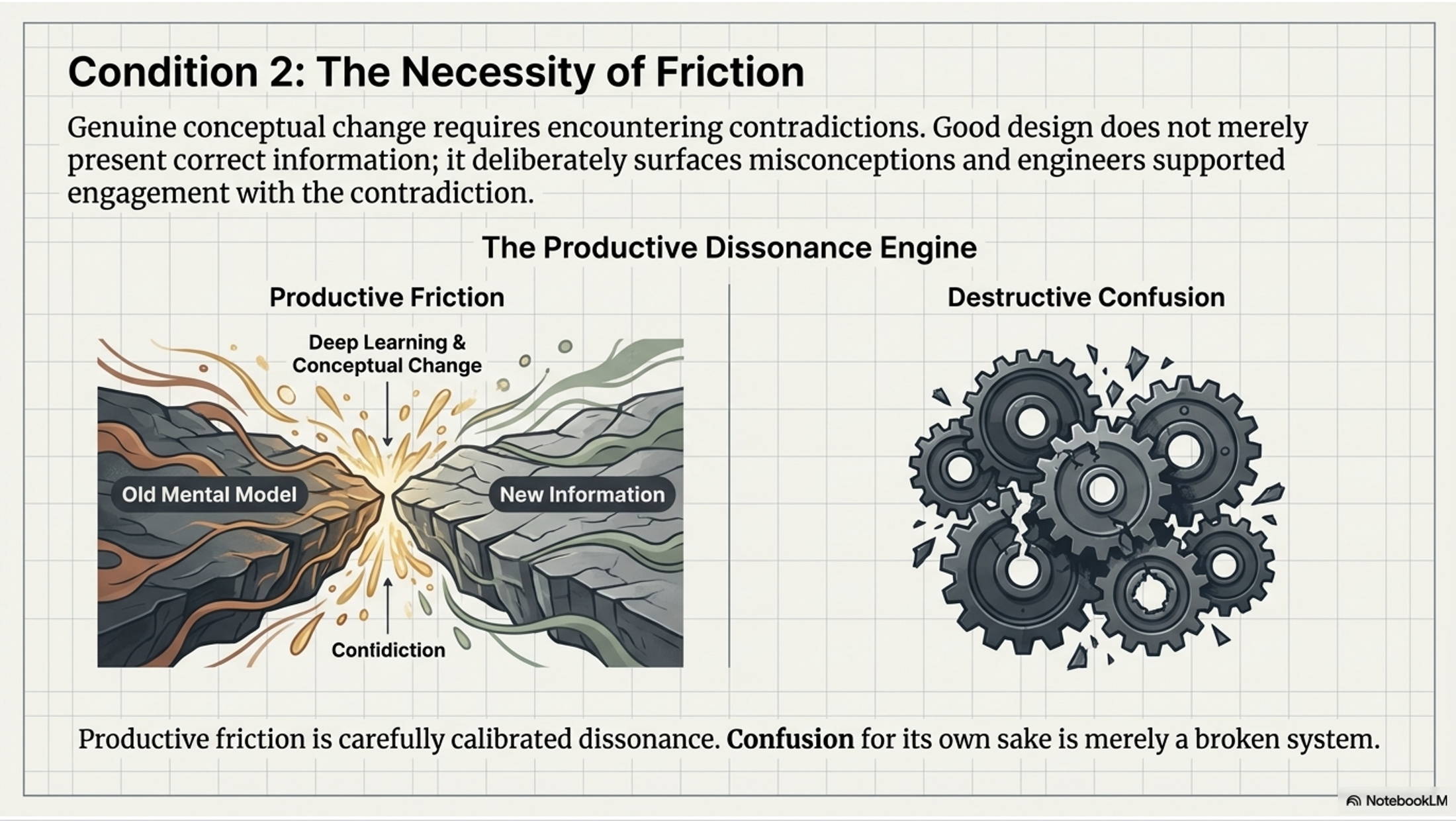
Constructivism suggests that genuine learning often requires encountering something that contradicts what you already believe. Research by Chinn and Brewer (1993) identified that conceptual change — the kind of deep learning that reshapes how someone understands the world — only occurs when new information is both comprehensible and challenging enough to create real friction with prior beliefs. Simply presenting correct information is rarely enough. The learner needs to feel the dissonance between old and new understanding.
As one analysis of constructivist teaching put it, learning "requires not just exposure to correct information but supported engagement with the contradiction between old and new understanding." This is why good teachers don't just explain — they surface misconceptions deliberately, set up situations where existing mental models fail, and then provide the structure for learners to rebuild.
The condition to design here is productive friction — not confusion for its own sake, but carefully calibrated encounters with ideas that don't quite fit the learner's current map of the world.
David Ausubel, whose influence on constructivism is substantial, put it memorably: "The most important single factor influencing learning is what the learner already knows. Ascertain this and teach accordingly." This principle sounds simple. It is devastatingly underused.
3. Psychological Safety
Here's one that rarely appears in instructional design frameworks, but probably should be foundational to all of them. It is very difficult for people to learn when they are afraid.
Amy Edmondson of Harvard Business School has spent decades studying what she calls psychological safety. She defines it as the shared belief that a context is safe for interpersonal risk-taking. Her research, originally conducted in hospital teams and later extended to organizations of all kinds, found that the conditions enabling people to ask questions, admit confusion, share mistakes, and try unproven approaches are not natural or automatic. They have to be deliberately cultivated.
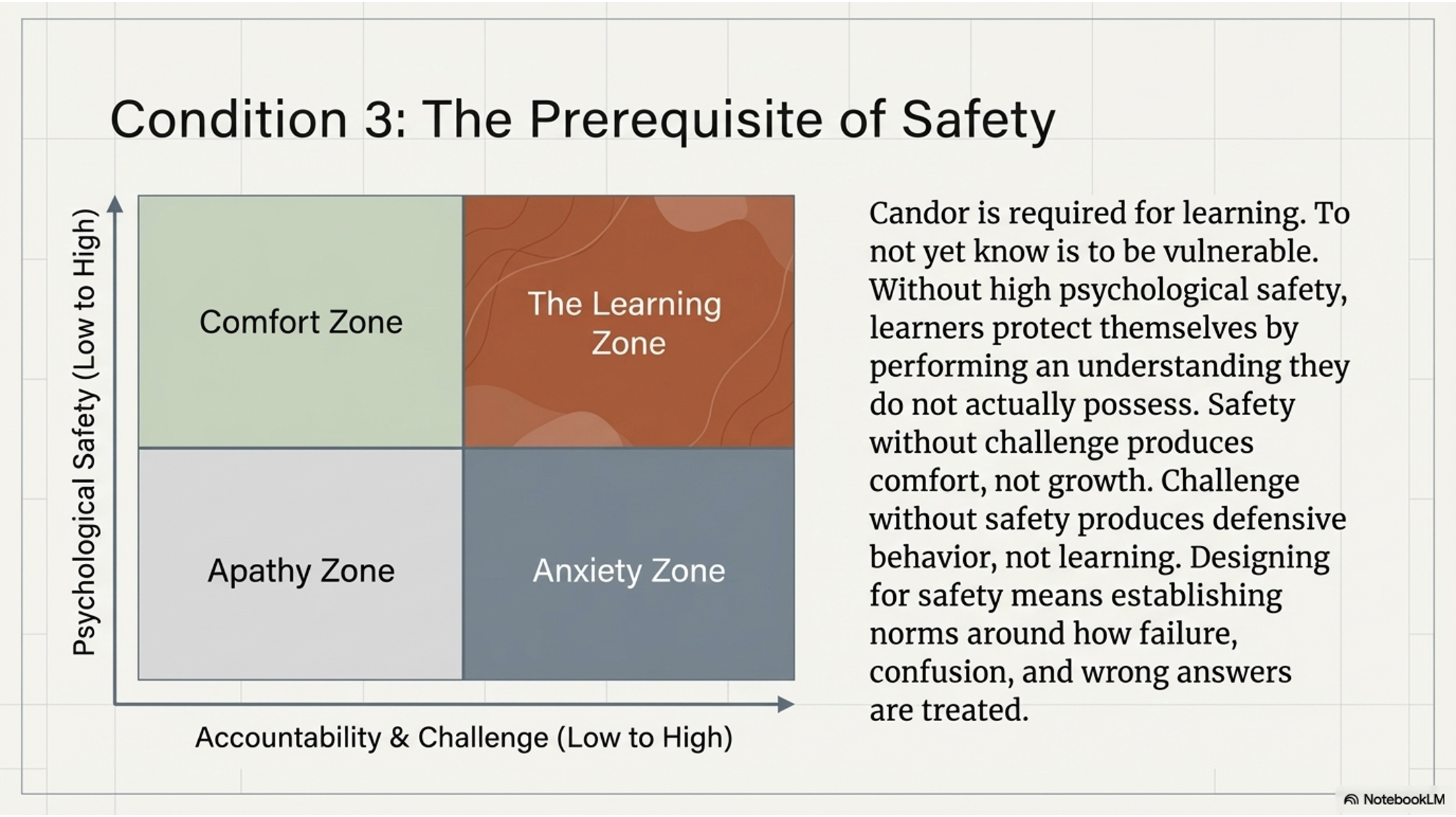
The link to learning is direct. Edmondson defines psychological safety as "the perception that candor is welcome", and candor is precisely what learning requires. To learn is to not yet know. To not yet know is to be vulnerable. If that vulnerability carries social risk then people will protect themselves by performing understanding they don't have. The appearance of learning replaces the thing itself.
Edmondson has described what she calls the "learning zone" as the intersection of high psychological safety and high accountability, where people feel safe enough to take risks and motivated enough to push toward excellence. Neither condition alone is sufficient. Safety without challenge produces comfort, not growth. Challenge without safety produces anxiety and defensive behavior, not learning.
Designing for psychological safety means attending to things that don't appear on most instructional design checklists: the way a teacher/facilitator responds to wrong answers, the norms established around asking questions, whether failure is treated as data or as judgment. These are environmental conditions. They are entirely designable. And they may matter more than anything in the curriculum.
4. Prior Knowledge as the Soil, Not the Obstacle
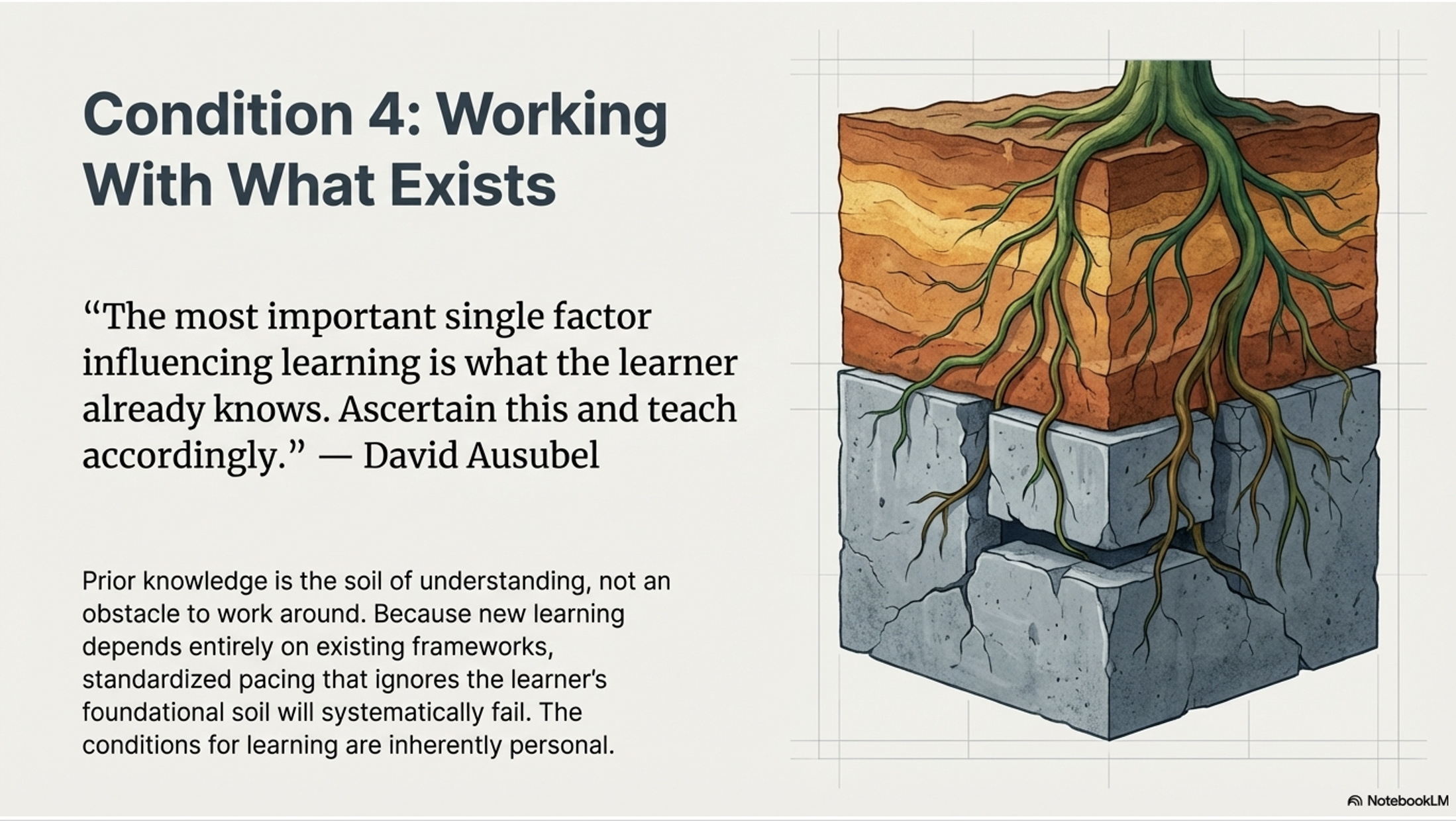
One of the most consistent findings in cognitive science is that new learning depends entirely on existing knowledge. Constructivism states that knowledge is built on the foundation of what is already known. Which means that what a learner already believes, correctly or not, is not something to work around but something to work with.
The condition to design is one in which learners' existing frameworks are actively engaged, surfaced, and used as scaffolding for what comes next.
This has an uncomfortable implication for many standardized learning experiences (where everyone receives the same content in the same sequence at the same pace). They are almost always systematically mismatched with how learning actually works. The conditions for learning are inherently personal.
On the contrary, if we do not systematically build on each lesson, then we’ll have all kinds of gaps in our classroom from mismatched learning experiences and prior knowledge.
This is why designing for learning conditions isn’t as easy as “plan for explicit instruction”. The big piece of the puzzle is next on our list.
5. A Cognitive Environment That Doesn't Overwhelm
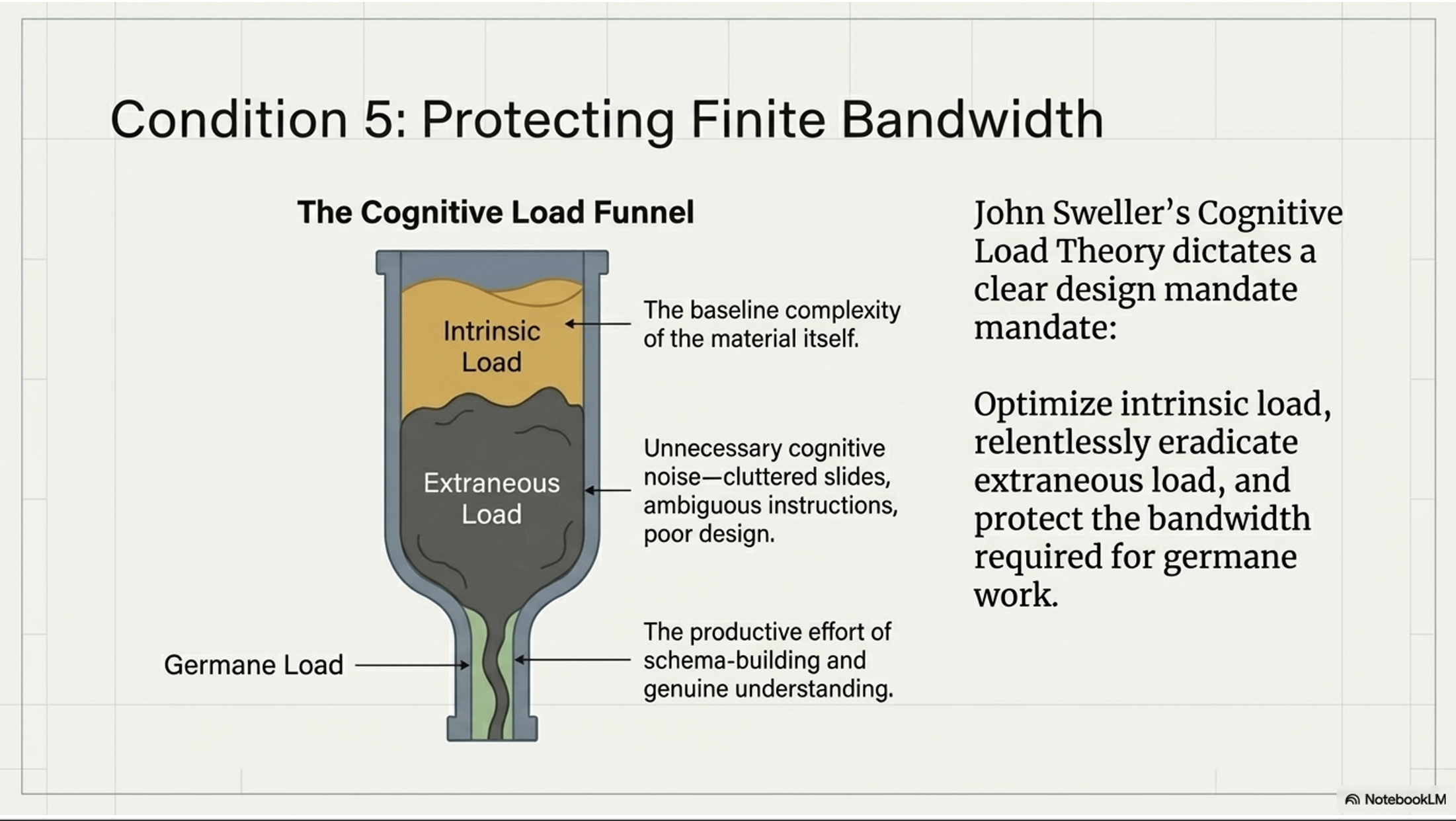
Even the most motivated learner in the most psychologically safe room will fail to learn if their cognitive architecture is overloaded. John Sweller's Cognitive Load Theory, developed in the late 1980s and refined extensively since, offers a simple reason why this is the case. The human working memory is severely limited, capable of holding and actively processing only a small number of elements at a time. When that capacity is exceeded, learning breaks down.
This is not because the learner isn't trying, but instead because the system can't cope. Think about how often we may overwhelm students with a project-based learning experience or open-ended assignment. Too many elements, too high a cognitive load if not chunked appropriately.
Sweller identified three types of load that compete for this finite resource. Intrinsic load is the inherent complexity of the material itself. It's relatively fixed for a given topic, but varies based on a learner's prior knowledge (what is complex for a novice may be trivial for an expert).
Extraneous load is the unnecessary cognitive effort imposed by poor design. Think cluttered slides, ambiguous instructions, irrelevant information, or formats that force the learner to mentally reorganize content before they can even begin to engage with it.
And, Germane load is the productive cognitive effort devoted to actually constructing new understanding and building long-term schemas.
The designer's job, through this lens, is to optimize intrinsic load by calibrating it to the learner's level of expertise, and relentlessly minimize extraneous load.
Every unnecessary step, every design decision that makes learners work harder without learning more, is stealing cognitive bandwidth that could have gone toward actual understanding.
Sweller's colleague Slava Kalyuga identified something particularly relevant called the "expertise reversal effect", and maybe you’ve experienced it. Instructional methods that work brilliantly for novices can actually impede learning for more advanced learners, and vice versa. Detailed worked examples that scaffold a beginner through every step become redundant and distracting for someone who has already built the relevant schemas.
This is a fundamental challenge to any one-size-fits-all instructional design. Intrinsic cognitive load is influenced by both the complexity of the material and the prior knowledge of the learner, which means the same content, delivered the same way, creates genuinely different cognitive experiences for different people in the same room.
6. Motivation as a Condition, Not a Given
All of the conditions above (the right challenge, the productive friction, the psychological safety, the managed cognitive load) share one assumption…that the learner wants to learn. But motivation is not something designers can simply assume or demand. It is itself a condition, one that has to be cultivated rather than commanded.
Richard Ryan and Edward Deci's Self-Determination Theory (SDT), now one of the most empirically robust frameworks in motivational psychology, makes this case the main condition of many learning experiences.
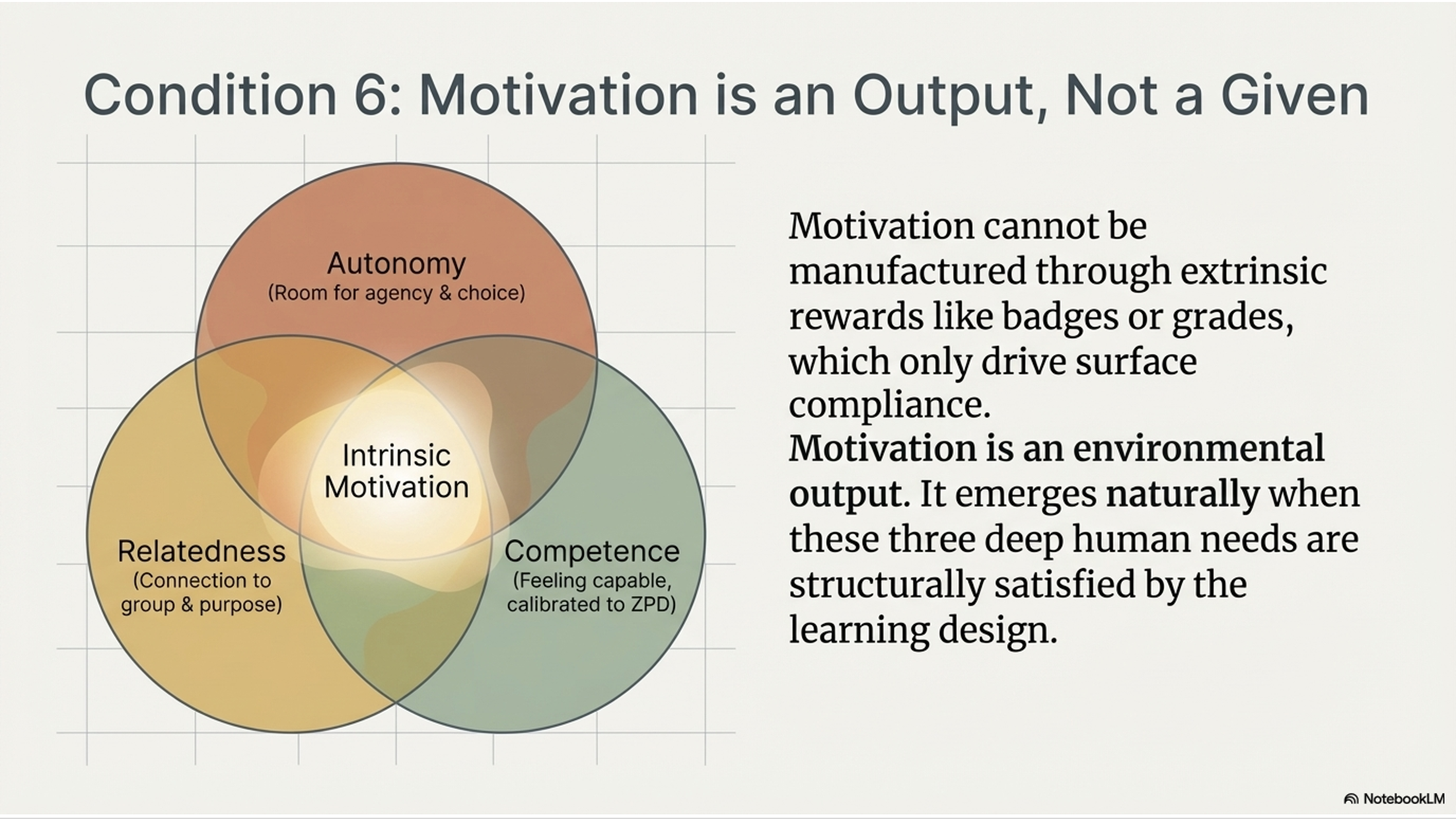
Their research identified three innate psychological needs - (1) competence, (2) autonomy, and (3) relatedness - which, when satisfied, yield enhanced self-motivation and well-being, and when thwarted, lead to diminished motivation.
These are deep human needs that determine whether a person engages genuinely with a learning experience or merely performs engagement to meet external expectations.
The implications for instructional design are simple and straightforward. Learners who feel no sense of autonomy (who are told what to learn, how to learn it, and when, with no room for agency) tend to disengage or comply superficially.
Students taught with a more controlling approach not only lose initiative but learn less effectively, especially when learning requires conceptual and/or creative processing. Learners who feel incompetent (remember ZPD) who are pitched material too far above their current level, or whose existing knowledge is never acknowledged struggle to access the intrinsic drive that makes sustained effort feel worthwhile.
AND learners who feel no connection to the teacher, the group, or the purpose of the work are far less likely to invest the full cognitive and emotional energy that deep learning requires.
This is why motivation cannot be manufactured through extrinsic rewards alone. Of course extrinsic rewards can help, but grades, badges, leaderboards, and completion certificates often only drive surface compliance.
The goal of the learning designer is not to incentivize learning but to create conditions where learners want to actually learn!
Designing experiences where the material feels relevant, where they experience themselves as capable, and where the environment signals that their curiosity and effort are genuinely valued.
Motivation, in this view, is not a personality trait the learner either has or lacks. It is an output of the environment. If we design the wrong environment and we will watch motivated people go through the motions. If we design the right one and we will find that people surprise you by going further than required, asking questions nobody prompted, and often connecting ideas across contexts you didn't anticipate.
What This Means for Designers
None of this means instructional design is futile. Quite the opposite. It means design matters enormously, but the object of design needs to shift.
Instead of asking "how do I teach this concept?" the better question is "what experience would make this concept learnable for this person, right now?"
Instead of designing only content, we need to be designing encounters (probably a better word but we’ll use that for now). These are situations in which learners are brought into productive contact with ideas that challenge and extend what they already know.
Dewey's framing remains the most elegant: "Give the pupils something to do, not something to learn; and the doing is of such a nature as to demand thinking; learning naturally results." The learning is the byproduct of a well-designed experience. You don't design the learning directly. You design the doing.
This is why explicit teaching matters especially when building foundational knowledge that can eventually be used to connect as prior knowledge.
This also means the best learning designers are like gardeners. Sir Ken Robinson used this analogy plenty of times. The gardener doesn't make plants grow. The gardener creates conditions like soil composition, light, water, support structures etc in which growth becomes possible.
Some plants flourish. Some need different conditions. The gardener's expertise is in reading what each plant needs and adjusting the environment accordingly.
The Humility This Requires
There is a certain loss of control implied here, and it's worth sitting with.
So, let’s sit with it.
If we accept that learning happens in the learner and not in the content, then we must also accept that we cannot fully predict, standardize, or guarantee it. We can create the richest conditions imaginable and some people still won't learn. We can provide modest conditions and some people will learn anyway, driven by their own curiosity and need.
What we can do (and what good educators, trainers, coaches, and facilitators do) is take the conditions seriously.
Is this learner in their zone of proximal development, or are we pitching below or above them? Is there enough challenge here to create genuine engagement, or are we just comfortable? Is this a psychologically safe enough environment that people will actually surface their confusion rather than hide it? Have we stripped away the extraneous cognitive noise so the learner's working memory can go toward the material, not the interface? And are we designing for motivation or are we just demanding engagement and wondering why we're not getting it?
These are not questions about curriculum per se. They are questions about conditions.
And that's the big shift. Learning is not a product we deliver. It is a process that happens when the right conditions are in place. Our job is to understand those conditions, design for them intentionally, and hold them lightly enough to adjust when they're not working.
We can't design learning. But we can design extraordinarily well for it.
Sources:
John Dewey
Experience and Education (1938) — Full text PDF via Internet Archive
Constructivism / Piaget / Bruner / Ausubel
University at Buffalo — Constructivism overview
Simply Psychology — Constructivism as a Theory for Teaching and Learning (Bruner, Ausubel, Piaget)
Chinn & Brewer (1993) is referenced in: Structural Learning — Constructivism in Practice
Vygotsky — Zone of Proximal Development
Simply Psychology — Zone of Proximal Development
Wikipedia — Zone of Proximal Development
Amy Edmondson — Psychological Safety
Original 1999 paper (full text PDF via MIT): Psychological Safety and Learning Behavior in Work Teams
Harvard Business School faculty page: HBS entry for the paper
Journal DOI: https://doi.org/10.2307/2666999
John Sweller — Cognitive Load Theory
Original 1988 paper: Cognitive Load During Problem Solving — Wiley Online Library
Full text PDF of the original paper: via Mr Barton Maths
Sweller, Ayres & Kalyuga (2011) Cognitive Load Theory book — available via Springer
Kalyuga — Expertise Reversal Effect
Kalyuga (2007) in Educational Psychology Review: Springer link
Full text PDF: via University of Kentucky
Wikipedia overview: Expertise Reversal Effect
Ryan & Deci — Self-Determination Theory
Ryan & Deci (2000) American Psychologist — PubMed: https://pubmed.ncbi.nlm.nih.gov/11392867/
Full text PDF via SDT website: selfdeterminationtheory.org
SDT theory overview: selfdeterminationtheory.org/theory