The Most Important Thing School Can Give a Kid Is More Than One Thing
Two athletes and two very different paths.
The first was putting against Bob Hope on national television at two years old, on The Mike Douglas Show in October 1978, with Jimmy Stewart looking on. His father had basically mapped out his entire development from the crib, and every piece of it pointed at one sport. You probably know how the story goes… Tiger Woods became one of the greatest golfers of all time.
The second kid played everything. Skiing, wrestling, swimming, skateboarding, basketball, handball, table tennis, badminton, soccer. His mother was a tennis coach, and she refused to coach him because he wouldn't return balls normally (and that must have annoyed her, I feel this as a parent haa). He didn't narrow in on tennis until his teens, well after many of his peers had committed to one sport. That kid was Roger Federer.
David Epstein, the former Sports Illustrated senior writer and ProPublica investigative reporter, opens his book Range: Why Generalists Triumph in a Specialized World with these two stories for a reason. (There's now even a version adapted for young readers, which I'd put in every middle school library.) We all know the Tiger story, because we build youth sports around it. Many of us build parenting around it, and if we're being honest, we build a lot of school around it.
But, the Roger story is the more common path to excellence…it just doesn't make for as good a headline.
The Case for Multiple Interests
I read a recent letter from Dan Koe making an argument that has serious ramifications in education. His point is that people with many interests have been told their whole lives that it's a weakness.
We’ve been told to pick one thing → Niche down → Get the degree, get the job.
Koe argues that this advice is a leftover from an economy built around narrow, repeatable tasks, and that in a world where AI can do more of those tasks, the rarest thing a person can offer is a perspective no one else has.
That perspective comes from the combination of everything they've pursued, and as he puts it, "Your edge lies more in intersection than it does in expertise."
He also makes a point I love: every interest you pursue leaves something behind. This leaves some a trail with more connections to draw on, a richer model of how the world works, and more problems you can actually see.
I don't agree with every piece of his framing. I think the "schools were built only to make factory workers" line is a bit too tidy as history (we explore that in my Learning 3.0 book). But, the core idea is right, and it lines up almost perfectly with what David Epstein found when he went looking at the research.
Kind and Wicked Worlds
The most useful idea in Range comes from Robin Hogarth, a psychologist at Universitat Pompeu Fabra in Barcelona. Hogarth described two kinds of learning environments.
Kind environments have clear rules, repeating patterns, and fast, accurate feedback. Golf. Chess. Firefighting drills. In these worlds, early and narrow specialization works, because the thing you practice at age eight looks a lot like the thing you'll face at twenty-eight.
Wicked environments are different than that. The rules are unclear or keep changing. Feedback is delayed, or missing, or misleading. Patterns don't repeat cleanly. Most of life works this way. Most careers work this way. Parenting, leadership, medicine, running a business, figuring out what to do with a new technology no one has seen before. In wicked environments, the people who thrive are the ones who can draw on many different experiences and adapt.
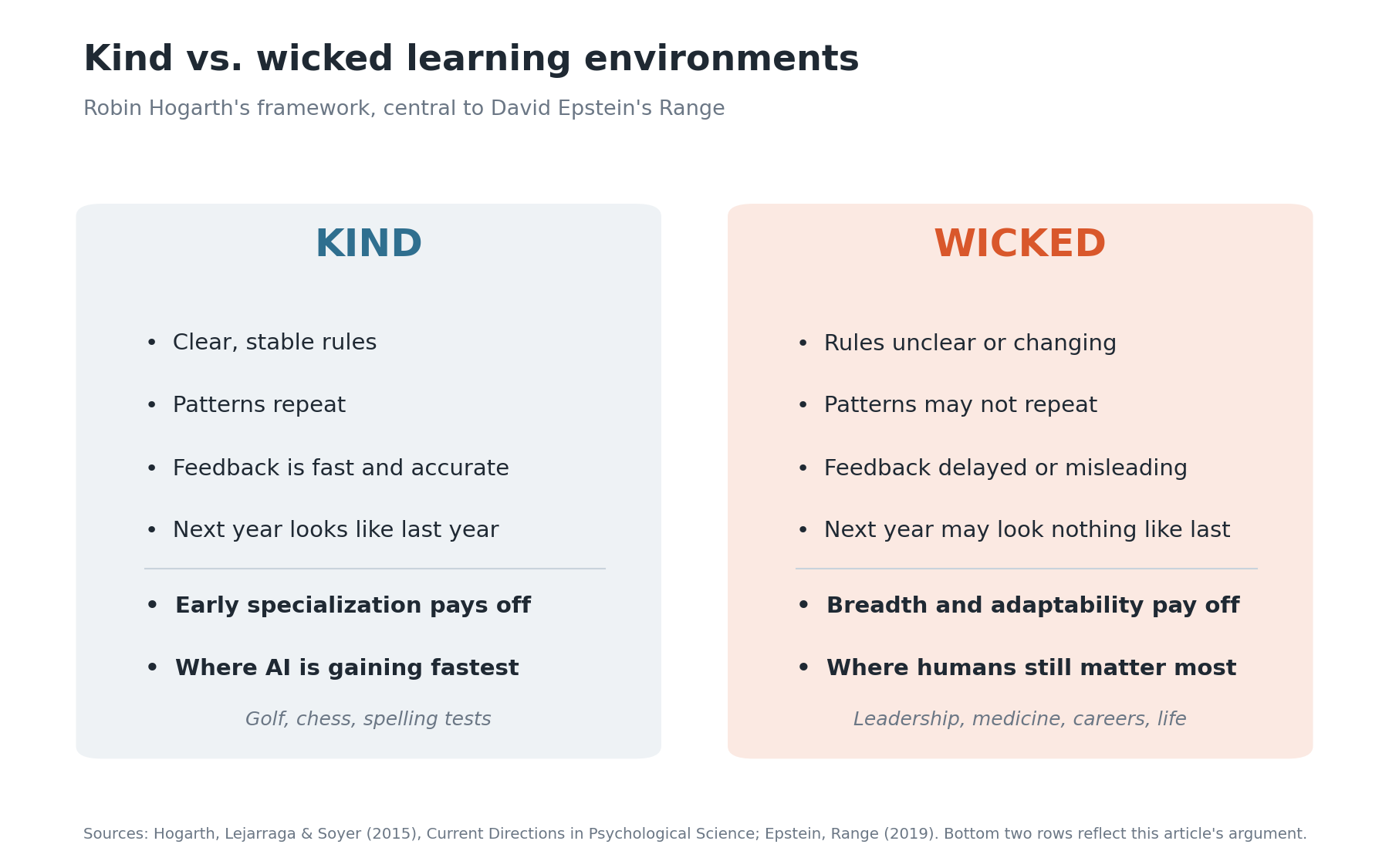
Here's why this matters so much right now. The kind environments are exactly where AI is getting good the fastest. Clear rules and tons of repeatable patterns are what these systems eat for breakfast. What's left for humans is increasingly the wicked stuff. Which means a school system optimized for narrow, early specialization is preparing kids for the part of the world that's being automated.
What the Research Actually Shows
This is not just a nice story about Roger Federer, because when we look at it the data keeps pointing the same direction.
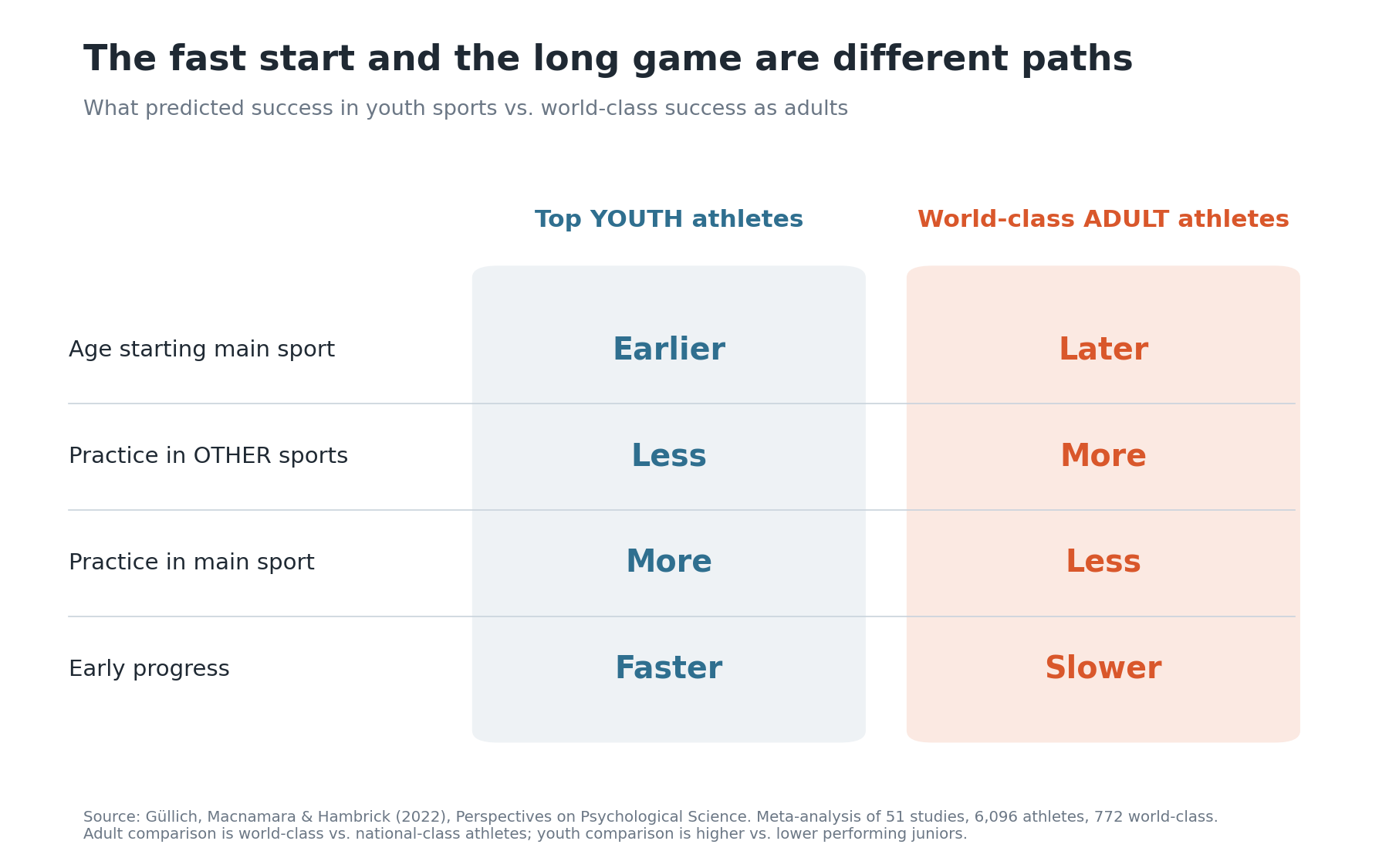
In 2022, Arne Güllich, a sport scientist at the University of Kaiserslautern, along with Brooke Macnamara, a psychologist at Case Western Reserve University, and David Hambrick, a psychologist at Michigan State University, published a large meta-analysis in Perspectives on Psychological Science. They pulled together 51 study reports covering 6,096 athletes, including 772 of the world's top performers. World-class performers typically started their main sport later, did MORE practice in other sports as kids, and progressed more slowly early on than athletes who topped out at the national level. Meanwhile, the kids who dominated youth competition were the ones who specialized early. As someone who has coached lacrosse for about 20 years, I've watched this play out over and over. The ten-year-old dominating the travel circuit is very often not the twenty-year-old still playing.
Outside of sports, economist Ofer Malamud (now at Northwestern University) compared students in England and Wales, who had to pick a specialized field before university, with students in Scotland, who sampled several subjects first. The early specializers had a head start in skills. But, they were more likely to switch out of their field entirely after graduating, often at real cost. Malamud's point was about what economists call "match quality," the fit between who you are and what you do. Sampling helped students find a better fit, while specializing early helped them get faster at something that often wasn't right for them.
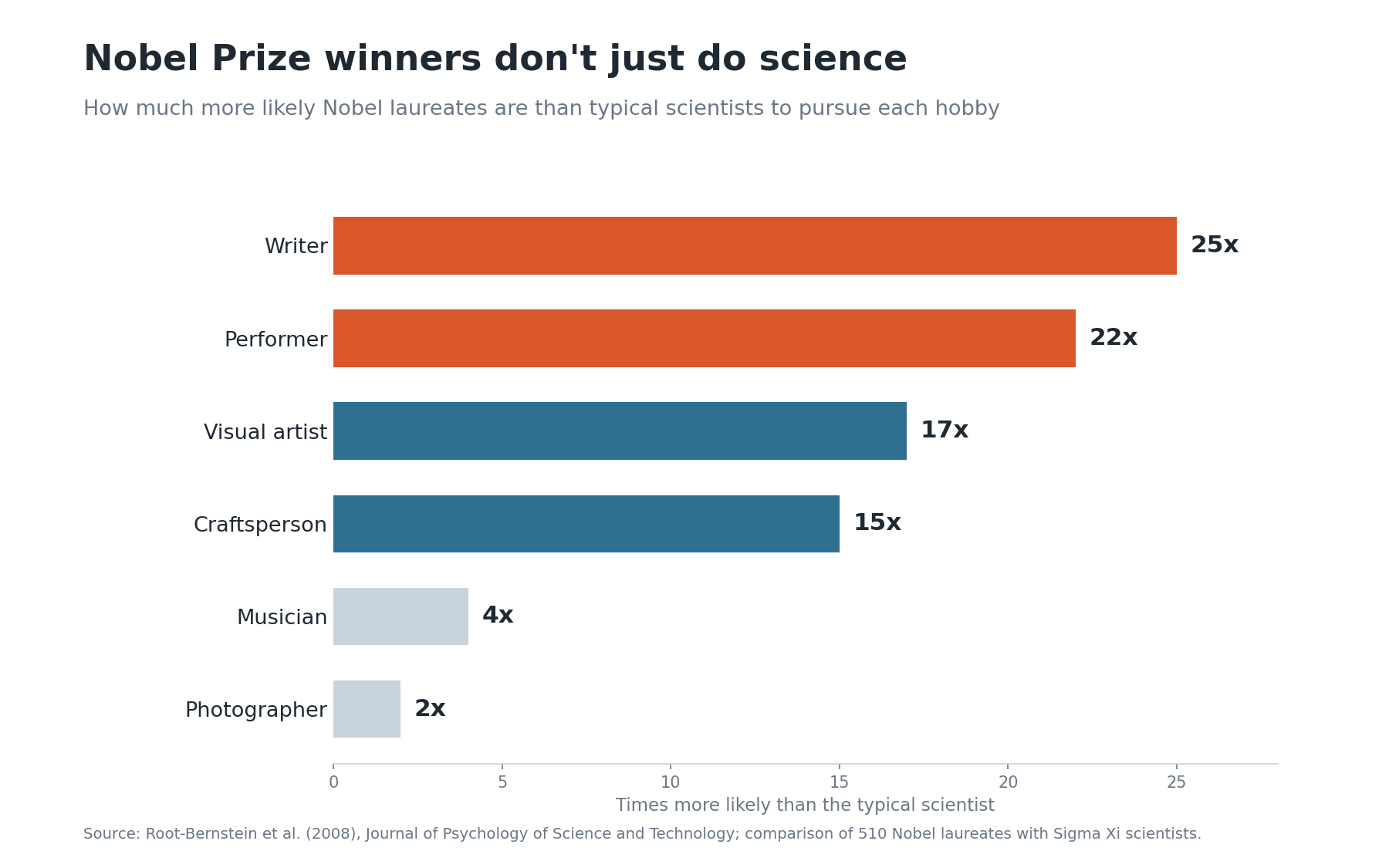
Robert Root-Bernstein, a physiologist at Michigan State University, studied Nobel laureates in science and found they were far more likely than their peers to have serious artistic hobbies. Compared with the typical scientist, Nobel winners were about 25 times more likely to write and 22 times more likely to perform as amateur actors, dancers, or musicians.
And Karim Lakhani, a professor at Harvard Business School, working with Lars Bo Jeppesen of Copenhagen Business School, studied open innovation challenges where companies posted tough unsolved science problems. Across 166 challenges and more than 12,000 scientists, solvers were more likely to crack a problem when it sat FURTHER from their own field…
Breadth Is Not the Same as Shallow
Range is not an argument against knowledge. Daniel Willingham (cognitive scientist at the University of Virginia) has spent decades showing that background knowledge is the substrate for critical thinking. You can't think well about something you know nothing about. David Epstein's example go deep, then go deep somewhere else, and then they connect the two. It's more like a sequential depth, not some endless shallow sampling over and over again.
The goal of school isn't to give kids a buffet of five-minute experiences. That doesn’t help anyone in the slightest. It's to give them multiple real opportunities to go deep in different domains, and then help them build bridges between them.
Making Range a Primary Goal of School
Right now, in most schools, multiple interests are something kids pursue in spite of school. Electives are treated like a reward for finishing the "real" work. Arts get cut first. Tracking starts earlier every year. Travel teams demand year-round commitment by age nine. Kids are asked what they want to be long before they've had the chance to find out what they're interested in.
What if we flipped it? What if one of the explicit goals of school was that every student leaves with multiple genuine interests, and knows how to connect them?
That would look different than what we have now, and we are going to explore this goal, and concept, in the next article titled: Portrait of a Graduate — Goals and Outcomes With REAL Impact.