What The PISA Results Really Show Us About Technology And Curriculum
The OECD released PISA 2025 on Tuesday, and the headlines basically wrote themselves.
Japan Today ran with teen reading slumping to its worst level this century because of screens. Education International pointed at shrinking attention spans and excessive AI use. OECD Secretary-General Mathias Cormann told reporters that more screen time and less reading for pleasure have moved together.
And so many countless posts on social media have highlighted parts of the results that speak to their talking points. Believe me. I get it. I really do.
Across OECD countries, reading fell 28 points between 2015 and 2025 and math fell 22. Those are the lowest averages recorded since the assessment began in 2000. In the United States, reading dropped 14 points to 490, which Education Secretary Linda McMahon described as roughly seven months of lost learning.
So here is my argument.
Technology in the classroom is not what caused this. And if your district builds its response around the assumption that it did, you will spend the next three years solving the wrong problem with real money and real teacher time.
I’ve written about this before. About how we love a “villain” each decade in US schooling/education. Right now we’ve gone from phones, to classroom tech, to AI in a very short period of time.
Some of these arguments are well placed as we’ll look at below. Others make very little sense. Let’s dig in.
Look at who is sitting at the top of the table
Singapore finished first in the world in reading and second in math, science, and computational problem solving. Its scores are 535 reading, 563 math, 560 science, 560 computational problem solving. The OECD average in reading was 461.
Singapore is not a country that keeps screens out of classrooms. Singapore's Ministry of Education launched the Student Learning Space as a national digital learning platform for every MOE school in 2018. In September 2023 it published the EdTech Masterplan 2030, whose stated vision is technology-transformed learning for a technology-transformed world. Every secondary student has a personal learning device. MOE has a published AI in education position built around students learning about AI, learning to use AI, learning with AI, and learning beyond AI.
Now let’s look at Estonia. Sixth in science, eighth in math, eighth in reading, seventh in computational problem solving out of 91 participating systems. Science is at 527, math at 508, reading at 499, computational problem solving at 541. Estonia and the United Kingdom were the only systems outside East Asia to land in the global top ten across the core domains.
Estonia has been the most aggressively digital school system in Europe for almost thirty years. Tiger Leap put computers and internet in every Estonian school in the 1990s. And, in February 2025, the Ministry of Education announced AI Leap, a national program giving 20,000 upper secondary students and 3,000 teachers free access to frontier AI tools from OpenAI and Anthropic, with teacher training first and student access second.
I’m not saying this had an impact on the scores. The timing obviously shows it did not. AI Leap launched on September 1, 2025 and PISA 2025 was administered before that. AI Leap did not produce these scores and I am not going to pretend it did, but what Estonia demonstrates is still really important. Their very deliberate three decades of wide-spread and government-backed classroom technology did not produce educational collapse. It produced the strongest system in Europe today.
It’s not all roses for Estonia either. Estonia's reading score also fell, 24 points below its 2018 peak, and Gunda Tire at Estonia's Education and Youth Board called that an alarm bell. It once again shows that reading is sliding almost everywhere. However, Estonia is sliding from a much higher floor while running the most tech-saturated schools on the continent.
The American timeline does not fit the story
This is the part I keep going back and forth with folks online and in person (who care to discuss which I think is good for education as a healthy debate).
If devices in classrooms broke American reading and math, we should be able to see the break line when and where the devices arrived. Unfortunately for those that want to make it seem cut and dry…we cannot.
The EdWeek Research Center surveyed district leaders about their pre-pandemic technology, and about two thirds recalled providing one school-issued device for every middle and high school student BEFORE COVID. Roughly 40 percent said the same for elementary. Most American 15-year-olds (the exact population PISA tests) were already living in one-to-one classrooms in 2018 and 2019.
So what did American PISA reading look like in that environment?
It looked like the best score the United States has ever posted. Around 505 in 2018, which was the highest mark across every cycle since 2000. Reading held between roughly 495 and 505 in every single American administration from 2000 through 2022. Math moved inside a band in the 470s and low 480s from 2003 through 2018 before dropping to 465 in 2022 and 463 in 2025. Science has been broadly stable since 2006. You can pull the trend files yourself from NCES.
Two decades of American classrooms going from one computer lab to a Laptop, iPad, or Chromebook on every desk. And the reading line barely moves in the PISA scores.
Then it falls off a cliff after 2022.
Whatever happened to American reading, it did not happen on the schedule of classroom technology adoption. It happened on the schedule of something else.
What the OECD actually found
Here is the strongest evidence for this argument, and it comes from the report itself.
The PISA 2025 executive summary says that limited or moderate use of digital devices for learning at school is often associated with better outcomes. Then it says that when the same devices are used for leisure during the school day, the relationship reverses sharply.
Same device. Opposite result. The reason is obvious. Scrolling TikTok is not the same as watching educational content. Playing a video game is not the same as adaptive math software.
It goes further. In schools with clear mobile phone policies (whether outright bans or well defined guidelines) fewer students report being distracted. In China, Japan, and Korea, fewer than 10 percent of students said classmates were distracted by devices in most science lessons. The OECD average was 28 percent.
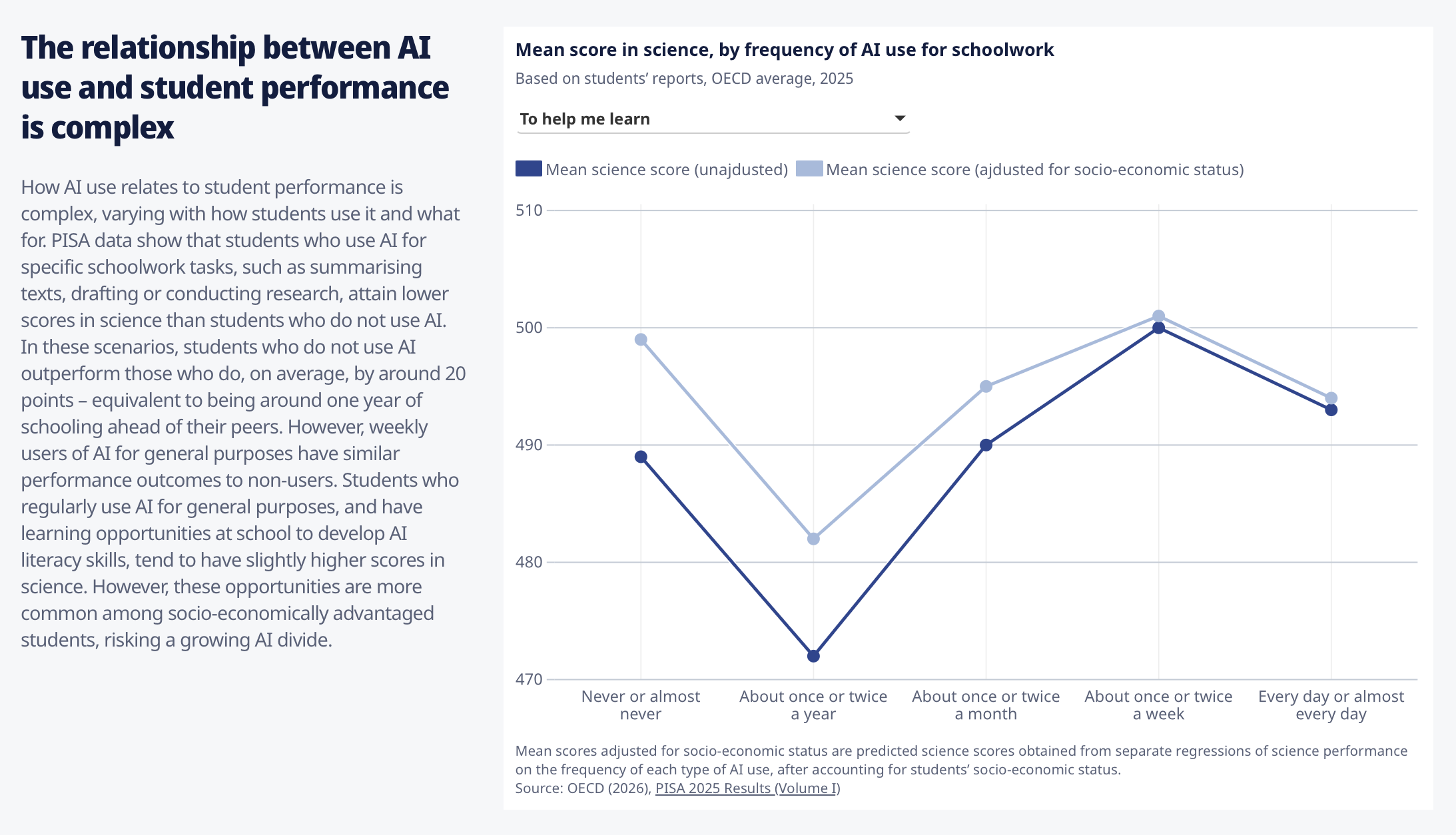
And if we want to focus on AI specifically, the OECD found something that almost nobody quoted. Among frequent AI users, students who used AI to help them learn and who had been taught how to evaluate the quality of AI output tended to outperform students who received no such instruction.
Taught being the key word here (more on that later).
When it is used the other way as “cognitive offloading” the results speak for themselves. Students who said they did not use AI to draft text for writing assignments outperformed students who did, and daily users scored meaningfully lower in science.
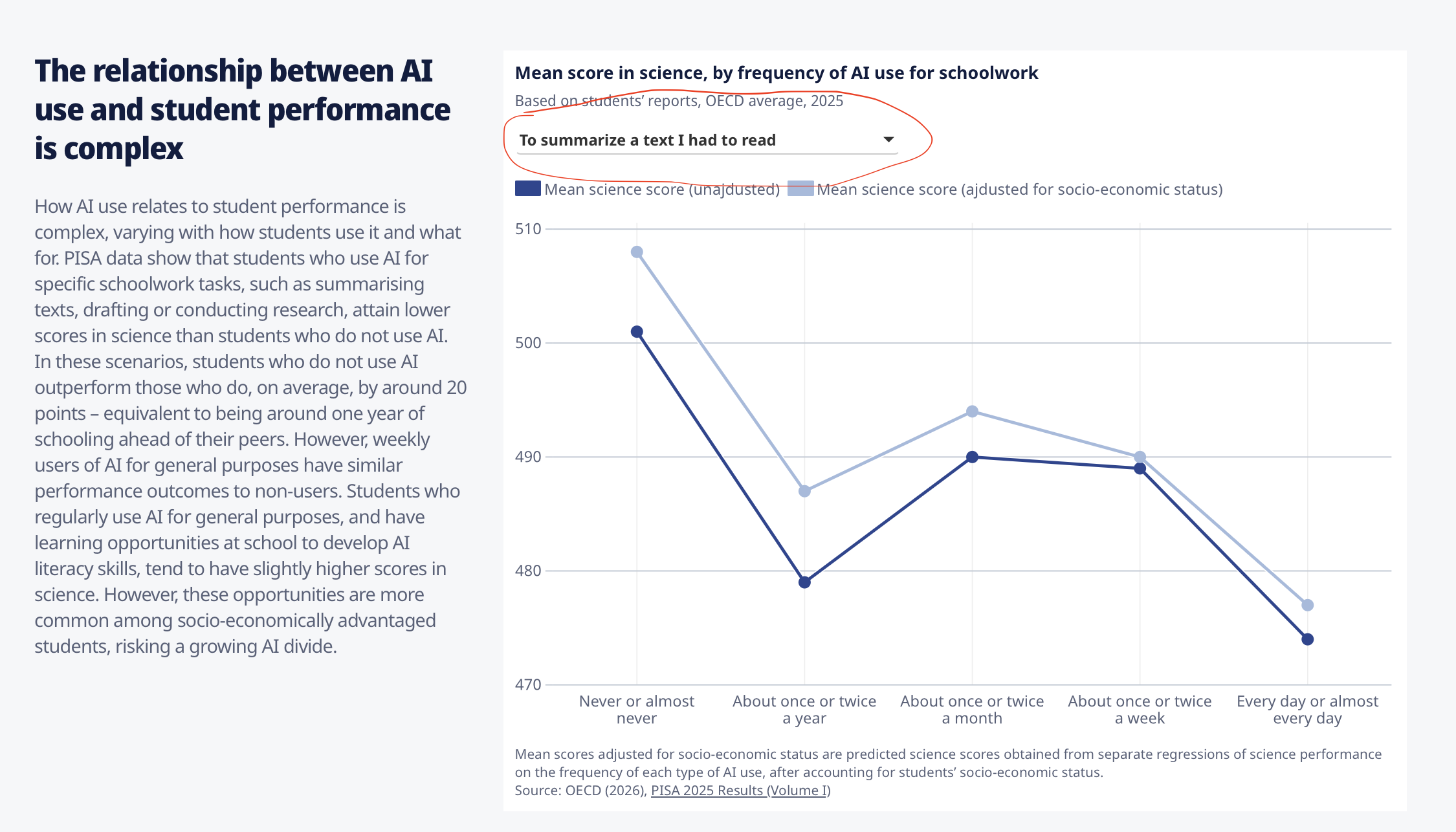
But look at what those students were doing. Drafting essays. Summarizing texts. Researching topics. That is not any type of purposeful technology use. That is a student handing over the exact cognitive work that produces learning. As the OECD points out, it’s complicated and more nuanced than we would like, even at the early stages of this technology use for learning.
Two things almost no one is putting in their headlines
The American sample has problems. The OECD flagged the United States this cycle because student and school response rates fell below minimum targets and exclusions exceeded allowed limits. Chalkbeat reported that more than 40 percent of American students who took the test never completed the accompanying questionnaire, and that the Education Department acknowledged a month-long pause in PISA activity in spring 2025. That is the same window in which contracts and staff were being cut at the Institute of Education Sciences. The OECD says it cannot rule out bias in the American results or determine its direction. Every confident causal claim about American scores this week should be seriously looked at.
Kids are not in the building. Chronic absenteeism rose from about 15 percent in 2019 to more than 28 percent in 2022 and was still hovering above 22 percent in 2025, with improvement slowing to under a point per year. Nat Malkus found elevated rates in every grade, including kindergartners who were newborns in 2020. That timeline fits the score collapse almost precisely.
Something we can all agree on?
Set the device argument down for a minute, because there is a country in this data that both sides of it should be looking at.
England.
While OECD averages fell 14 points in reading and about 10 in math, England held. Its reading score was 497, essentially flat against 496 in 2022. Math sat at 492, the same as three years earlier, against an OECD average of 463. Science improved outright. England moved to eighth in the world in science, up from thirteenth, joint ninth in reading, up from thirteenth, and tenth in math. Professor Mary Richardson at UCL, lead author of the national reports, noted that English 15-year-olds were reading about as well as they were in 2022 despite the global slide.
England did not do that with a technology strategy. It did it with a curriculum strategy.
Starting around 2010, England rebuilt its national curriculum around specified content knowledge, introduced the Year 1 phonics screening check in 2012, and aligned its assessments to what was actually being taught. That is the science of learning translated into actual policy.
The Department for Education's own PIRLS 2021 national report found the Year 1 phonics check to be the single most powerful predictor of reading performance four years later, with each additional point on the check associated with almost four points in PIRLS. The same report found that students who reported more than 200 books at home outscored students with ten or fewer by roughly 56 points. Phonics and books leading to decoding and knowledge. There is not one device in that sentence.
To be fair, the Education Policy Institute has argued that PIRLS trends do not show a clear effect from the check itself, and England's own DfE said this week that it does not want to climb the tables solely because other countries are falling. England's math score is still 12 points below where it was in 2018.
But, the direction of the argument holds. Nobody looking at England is saying the difference is Chromebooks or the absence of them (well, maybe some folks want to make that argument). The difference is what got taught, in what order, with what evidence behind it, and how much of the cognitive work stayed inside the student's head.
That is the actual fight we should all agree on.
It’s too simplistic to say the debate between well-performing school systems and struggling school systems is screens versus paper.
Technology can serve every one of those things above or undermine every one of them, and it will do whichever one your curriculum tells it to do.
So what can we ACTUALLY take away from the PISA results when it comes to technology?
Write a clear phone policy and enforce it, because the OECD data on distraction is unambiguous and the fix is cheap.
Separate learning tech use from leisure tech use during the instructional day, since that single distinction flips the correlation.
Teach students to evaluate AI output as an explicit, assessed skill, because the guided frequent users outperformed the unguided ones.
And protect the hard part of every assignment. If the thinking that produces the learning can be handed to a machine, redesign the task until it cannot.
Singapore and Estonia did not win this cycle by keeping technology out. They won it by refusing to let technology decide what students do with their minds.
Sources: OECD, PISA 2025 Results Volume I; OECD press release, 8 September 2026; OECD executive summary; OECD United States country note; OECD Singapore country note; OECD Estonia country note; NCES PISA; Singapore MOE EdTech Masterplan 2030; Estonian Ministry of Education, AI Leap; EdWeek Research Center; AEI Return to Learn Tracker; Chalkbeat; K-12 Dive; ERR News.