School Leaders: Autonomy Is Not the Opposite of Alignment
Every school leader I talk to right now is running the same math in their head.
If we get everyone aligned, I might lose my best people. If I give everyone room and autonomy, we will lose any sense of coherence.
Someone at a leadership retreat I was leading, said the quiet part out loud, “that is the job in 2026.”
Attendance is still tough to gauge and an issue. Cell phone and technology policy has become a political event. The reality is your teachers are most likely in three different camps on AI, and all three think they are the reasonable one.
Enrollment is most likely down, homeschool on the rise, the budget is worse, and somebody wants to talk about the reading curriculum again.
The numbers back up all those feelings.
RAND's 2026 State of the American Teacher survey found 18 percent of teachers intended to leave their jobs, and RAND has repeatedly found that teachers and principals report frequent job-related stress at roughly twice the rate of similar working adults. That is a system problem at the highest level…
And most of us respond to a system problem with a lever we already know how to pull.
We buy “alignment” by spending “autonomy”.
Let me explain.
New template. New walkthrough form. New requirement that used to be a suggestion. It works for about six weeks, and then compliance sets in, and compliance looks exactly like alignment right up until the moment you need somebody to think.
Or we do the reverse. We protect autonomy by quietly abandoning alignment. We say we trust our people, which is true, and we say we are not going to micromanage, which is also true, and what we actually communicate is that nothing here matters enough to be firm about. Fifty teachers make fifty reasonable decisions. A kid moves from third period to fourth period and enters a different country.
Both moves assume the same thing. That autonomy and alignment sit on one dial, and your only real decision is where to set it.
They do not. They are two separate axes, and every school sits somewhere on both.
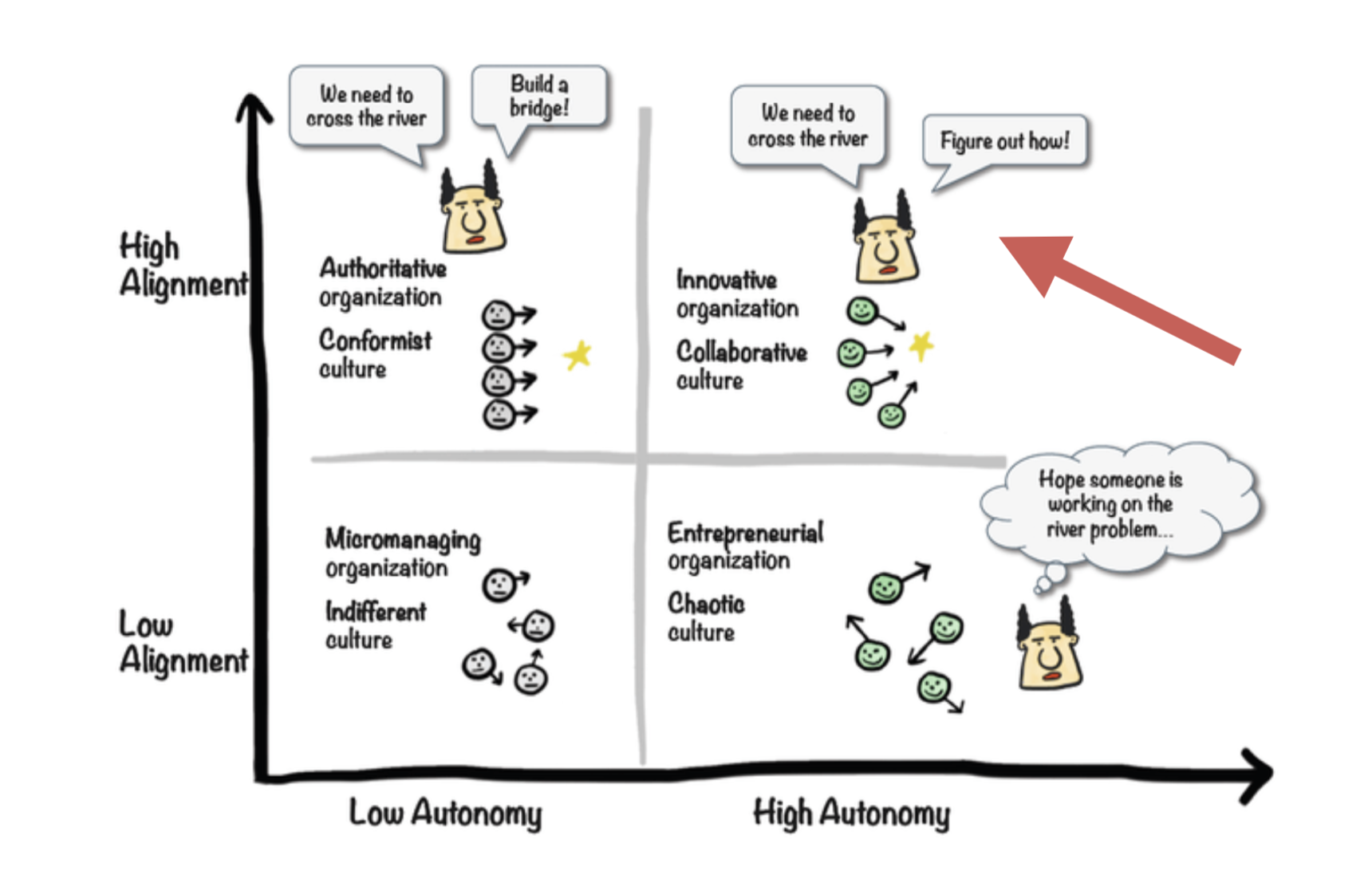
Bottom Left: Low on both is drift, and you can feel it the second you walk in the building.
Top Left: High alignment and low autonomy is compliance, which is stable, quiet, and slowly crippling to anyone good.
Bottom Right: High autonomy and low alignment is a collection of a few excellent individual classrooms, and some that aren’t working, and does not add up to a school moving in the same direction.
Top Right: High on both is the only one worth building. It is also the only one that requires you to decide something.
A Lesson From 1954
In the spring of 1954, the National Foundation for Infantile Paralysis ran the largest medical field trial in American history, and it ran it through public schools.
The scale was roughly 1.8 million children. 15,000 public schools across 44 states served as clinic sites. There was somewhere around 20,000 physicians and public health officers, 64,000 school personnel, and 220,000 volunteers, in what became the largest peacetime mobilization of volunteers the country had seen. Every result was tracked on paper, by hand, by people who were not scientists.
Thomas Francis Jr. of the University of Michigan ran it, and when the Foundation asked him to lead the evaluation, Francis made a demand that nearly destroyed the whole operation...
He insisted on a double blind, placebo-controlled design. Half the kids would get saline, and no one (not the parent, not the doctor, not the child) would know which group got the placebo.
Many on the team pushed back, arguing that doctors should not be deliberately giving children something that would not protect them. Others argued becuase they wanted speed, but Francis wanted the answer to be TRUE.
In the end, he got it, and the alignment that was necessary.
Now look at what was NOT specified.
How your PTA ran the parent night.
How your school handled the permission slips.
Who staffed the folding table in the gym.
How you scheduled around lunch.
Which room.
Which nurse.
What you told a scared 8-year-old rolling up his sleeve...
15,000 schools solved 15,000 versions of that problem, locally, with almost no help from anyone in Ann Arbor.
Francis held one thing with absolute rigidity. He held it against the inventor of the vaccine and against his own funder. The autonomy of those 15,000 schools was a direct result of the ONE THING that was aligned.
That is the relationship most of us miss. The short list of alignment is what MAKES autonomy possible, because it is the only thing that lets you stop supervising everything else.
And 2024…
Here is the modern version, and it is happening in a place most people were not necessarily watching.
Louisiana does not mandate a state curriculum. The state runs teacher-led reviews of instructional materials and publishes them in tiers. The language on the state's own site says Tier 1 means a resource "meets all non-negotiable criteria and scored the best possible on all indicators of superior quality”, while Tier 3 means it "does not meet non-negotiable criteria."
This is non-negotiable, and Louisiana has it published, reviewed by teachers, and sitting on a public website where any parent can read it.
That is the ALIGNMENT.
Right after that on the same public-facing website, it says this:
Every local school system decides for itself whether a resource fits its students.
What Louisiana did was publish a floor, and then made choosing well the easy thing to do through discounted state contracts and aligned professional learning.
On the 2024 NAEP, Louisiana was the only state whose 4th grade reading score exceeded its 2019 level, moving from 210 to 216, just above the national average of 214. The state's composite ranking across fourth and eighth grade reading and math went from 49th in 2019 to 32nd.
The alignment was key to this as Louisiana also required K-3 science of reading training and banned “three cueing:. Multiple things moved at once, and FutureEd's own analysis notes it is not clear which steps caused the gains. I am not telling you curriculum tiers produced six NAEP points.
What I am telling you is that Louisiana refused the trade. It got more specific about the floor and MORE deferential about the choice, at the same time, which is exactly the strategy most systems tell themselves is impossible.
The state was aiming for Top Right with high alignment and high autonomy.
What this means for us as School Leaders
The real decision is deciding what you are willing to be immovable about.
That decision is time-expensive. If you name four non-negotiables, you have to defend four non-negotiables, in public, to a board member and a parent and a beloved veteran teacher who has done it another way for nineteen years.
When we did this work at Upper Perkiomen School District, a team of district leaders, teachers, board members, community members and some students met multiple times.
In the end, we crafted our Core Learning Principles. The principles that we would run current and future decisions through.
Most of us would rather write twelve priorities, because twelve priorities is a document, and four core principles that are non-negotiables can be a fight.
But, twelve priorities is not alignment. It is basically a hedge, and it costs your staff exactly as much autonomy as real alignment would, while delivering none of the clarity.
So try this instead →
Write down every non-negotiable you actually have. These are the ones you would enforce on a Tuesday in February when you are tired and the person on the other side of the desk is your best teacher. If the list is longer than five, it is more likely a wish list.
Then say the sentence you have never said out loud. Here is what we will not move on, and here is everything else, and everything else is genuinely yours. People cannot use autonomy they are not sure they have. Unstated freedom gets treated as a trap, and your staff will keep asking permission for things you already gave them.
Then hold the short list when it costs you something. Francis held his protocol against others who wanted things the easy way. That is always the price. An alignment you abandon under pressure was more of a preference…and needs to be worth the fight.
The AI conversation in your building is going to test this within the month. It’s why I wrote my book, Learning 3.0: The Fight For Human Learning In The AI Age.
We spend our careers arguing that students learn more when they have real choices inside a real structure. Deci and Ryan have forty years of work showing that autonomy is not a reward for competence, it is a condition of motivation.
And then we often build schools where the adults have neither.
You cannot hand a kid agency from inside a system that has taken it from every adult in the building.
Pick the short list. Defend it in public. Then do the hard work of holding the standard high while supporting the autonomy needed to get there.
Sources
RAND, Teacher Well-Being, Pay, and Intentions to Leave in 2026: https://www.rand.org/content/dam/rand/pubs/research_reports/RRA4400/RRA4404-2/RAND_RRA4404-2.pdf
RAND, teacher and principal stress at twice the rate of similar working adults: https://www.rand.org/news/press/2022/06/15.html
JAMA Pediatrics, "Making History: Thomas Francis, Jr, MD, and the 1954 Salk Poliomyelitis Vaccine Field Trial": https://jamanetwork.com/journals/jamapediatrics/article-abstract/349158
CBS News on the Francis Field Trial and Salk's objection to the placebo design: https://www.cbsnews.com/news/the-salk-polio-vaccine-greatest-public-health-experiment-in-history/
HISTORY, "When Public Schools Became Vaccine Trial Sites": https://www.history.com/articles/vaccine-trials-schools
Louisiana Department of Education, Curricular Resources Annotated Reviews (tier definitions): https://doe.louisiana.gov/school-system-leaders/instructional-materials-reviews/curricular-resources-annotated-reviews
EdReports, "Louisiana's Education Model: A Student Improvement Blueprint": https://edreports.org/resources/article/louisianas-education-model-a-student-improvement-blueprint
NAGB, 2024 Nation's Report Card release: https://www.nagb.gov/news-and-events/news-releases/2025/nations-report-card-decline-in-reading-progress-in-math.html
FutureEd on the 2024 NAEP results and the causation caveat: https://www.future-ed.org/the-new-naep-scores-highlight-a-standards-gap-in-many-states/