Looking Ahead to 2026: Education at a Crossroads
In classrooms across the globe, a profound shift is taking place. Students who once complied with compliance-based educational models are increasingly disconnected, their attention fragmented by a digital landscape that evolves faster than our curriculum. As educators, we find ourselves at a critical moment, faced with unprecedented challenges, yet presented with remarkable opportunities to reimagine learning for a new era.
These challenges touch everyone in the educational ecosystem—elementary and secondary teachers, school leaders, and parents alike. While some educational hurdles lie beyond our immediate control (staffing shortages, funding constraints, and retention issues) there exists a realm of challenges in which our individual and collective influence can create meaningful change.
All of us, as educational stakeholders, can make a difference by addressing the impacts on learning from technology, artificial intelligence, and distraction.

The central premise of this work is straightforward but powerful. Rather than merely attempting to solve these challenges through restriction and removal, we can transform them into catalysts for educational evolution. While certain boundaries remain necessary (few would argue that students should have unfettered access to phones throughout the school day) wholesale technological elimination is neither practical nor beneficial. Even if we wanted to eliminate tools like generative artificial intelligence from classrooms, students would simply access them elsewhere. We must embrace a more nuanced approach that acknowledges our new reality while enhancing educational outcomes.
The Engagement Challenge
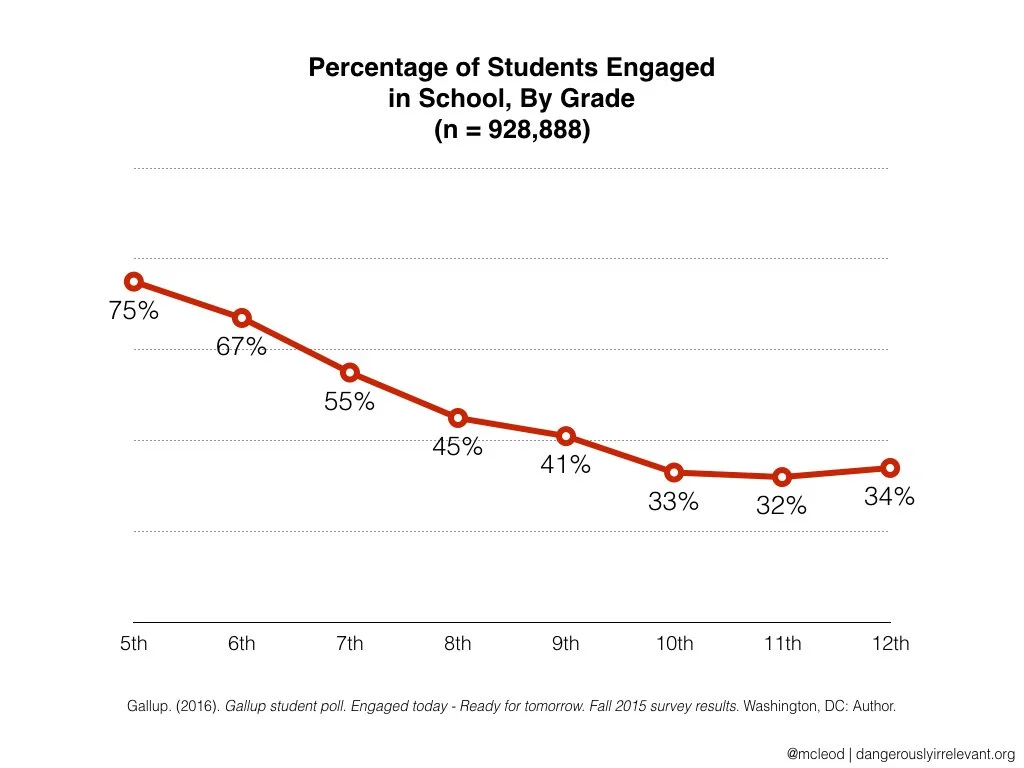
Perhaps the most visible symptom of our educational crossroads is the attention crisis. Engagement levels have measurably declined, with students increasingly disengaged from compliance-based instruction. Research consistently demonstrates this troubling trend, yet I see this not as a dead end, but as a powerful opportunity.
When students reject our long-standing compliance model—the approach where they complete tasks primarily motivated by grades—they are signaling the need for genuine transformation. This rejection invites us to move beyond compliance toward meaningful engagement through relevant activities, lessons, units, and assessments that connect with students’ lives and interests. The attention crisis, viewed through this lens, becomes an invitation to create learning experiences that students find inherently valuable.
The Curriculum Dilemma

Most of the curriculum remains outdated and static, unable to adapt to rapidly changing circumstances. When educational disruptions occur—whether technological innovations, such as AI, or global events, such as the pandemic—rigid curriculum frameworks become barriers rather than supports.
As Wiggins and McTighe point out in their fantastic book, School By Design, the Curriculum and Assessment system of a school is one of the foundational building blocks that everything else is resting on.
The opportunity here lies in developing organic, relevant learning experiences and moving away from static assessments toward authentic performance tasks. When the pandemic forced educational upheaval, it was not textbooks or programs that demonstrated adaptability—it was educators.
By embracing curriculum flexibility, we can build educational experiences that evolve alongside our changing world, rather than lagging perpetually behind it.
The AI Revolution

Artificial intelligence has fundamentally changed what constitutes authentic student work. Applications such as Photomath can solve complex problems with detailed steps, while language models can generate essays that are indistinguishable from student writing. The next generation of AI tools promises even more sophisticated capabilities, with upcoming versions potentially able to write book-length content from a single prompt.
Rather than engaging in an unwinnable verification battle, we can pivot toward assessments that emphasize process over product.
Finding meaningful reasons for learning beyond grades—through formative and performance-based approaches—and by evaluating the learning journey itself, we make AI assistance less relevant. When assessment focuses on the development of understanding rather than the final product, the educational experience becomes both more authentic and less susceptible to technological shortcuts.
The Social Development Imperative

Students are struggling socially at unprecedented difficulty—a concern voiced consistently by both teachers and parents. This challenge presents an opportunity to prioritize collaborative learning journeys that develop interpersonal competencies alongside academic ones.
Instead of worksheet collaborations, we can design experiences where students must genuinely work together toward shared goals, much as they do in extracurricular settings like teams, bands, or clubs.
Students already demonstrate remarkable collaborative abilities in their nonacademic lives, particularly in gaming environments where they coordinate complex missions with peers. By creating academic analogues of these naturally engaging collaborative experiences, we address social development needs while enhancing learning outcomes.
The Time Constraint Reality
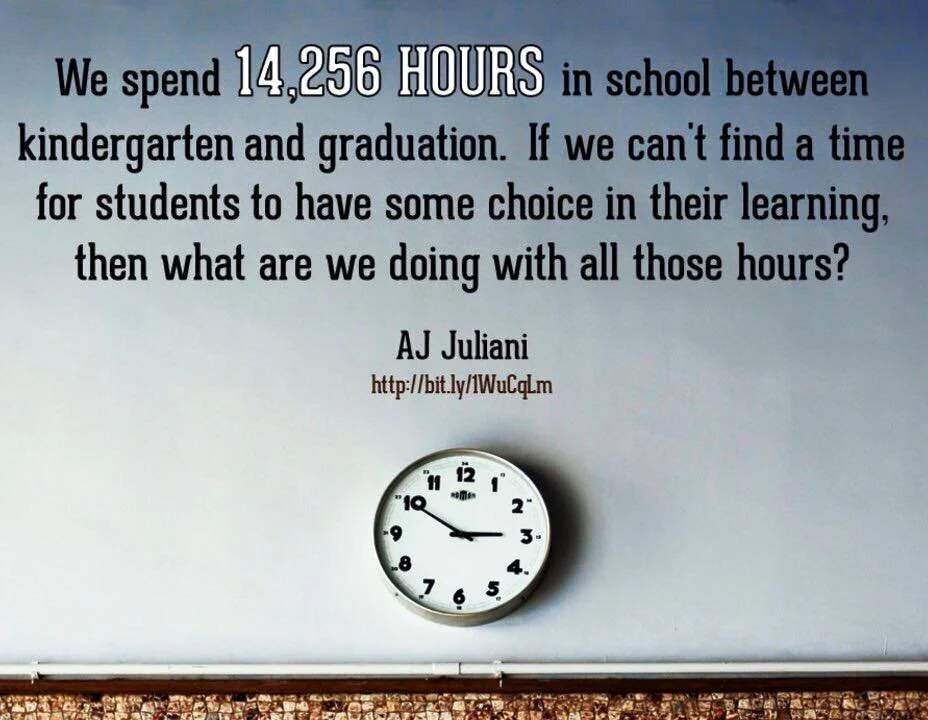
The overwhelming numbers of standards and units of study have created a pervasive time scarcity that undermines deep learning. Teachers consistently report feeling rushed and unable to explore topics thoroughly before moving to the next curricular demand.
One promising approach involves reconfiguring learning into focused “sprints” that achieve depth without excessive duration. Project-based learning, often perceived as requiring weeks or months, can be condensed into two- or three-day intensive experiences that maintain educational integrity while fitting realistically into crowded academic calendars. This approach honors both curricular requirements and the need for meaningful engagement.
The Data Direction Challenge

Educational data and metrics, while potentially valuable, are frequently misapplied in ways that diminish rather than enhance learning. As data science becomes increasingly central to education over the coming decade, we must ensure it serves rather than directs our pedagogical approach.
The opportunity lies in adopting what author George Couros describes in The Innovator’s Mindset (2015) as a “learner-driven, data-informed” stance—one that maintains the irreplaceable human elements of education while leveraging information to improve outcomes. This balance highlights the critical role of teachers as relationship-builders and facilitators who understand learners in ways that algorithms never can, regardless of their sophistication.
Each challenge outlined above corresponds to research-based opportunities that have emerged just within the past decade. These are not theoretical possibilities, but evidence-supported approaches developed during and after the pandemic, specifically addressing the realities of today’s educational situation.
The path forward isn’t about eliminating technology or returning to simply an idealized past (although many are arguing on both sides of that aisle). Instead, it involves reimagining education for a world where distraction is constant but engagement remains possible. I believe 2026 can be the year where we acknowledge new challenges while embracing the opportunities they create for meaningful and relevant learning.
What If We Don’t?
What if we respond to this moment by tightening policies, doubling down on compliance, and hoping the noise fades?
Then education doesn’t just fall behind, it becomes increasingly irrelevant to the world students are already living in.
Artificial intelligence is a minor disruption to our compliance=based model. To put it another way, it’s probably the opening act.
Personal robots will move from novelty (and something we never think will happen) to normal in homes, businesses, and yes, most likely, schools.
Quantum computing will redefine what “hard problems” even mean.
CRISPR and genetic technologies will challenge our ethical frameworks as much as our science standards.
Wearable and implantable devices will blur the line between human capability and machine augmentation.
If our systems struggle now to adapt curriculum, assessment, and engagement, they will fracture under what’s coming next.
The cost of inaction won’t show up all at once, it will more likely appear gradually. We are already seeing declining trust. We know there are more disengaged learners than ever before.
This moment is not a crisis that we have to “get through”. It is instead a crossroads to choose from. We can begin reshaping learning to be meaningful and human (and hopefully adaptable).
Or we’ll have to wait until change is forced upon us, at a pace and scale we no longer control. This is just the beginning.